
Wikipedia Definition: Patient safety is a discipline that emphasizes safety in health care through the prevention, reduction, reporting, and analysis of error and other types of unnecessary harm that often lead to adverse patient events. The frequency and magnitude of avoidable adverse events, often known as patient safety incidents, experienced by patients was not well known until the 1990s, when multiple countries reported significant numbers of patients harmed and killed by medical errors. Recognizing that healthcare errors impact 1 in every 10 patients around the world, the World Health Organization calls patient safety an endemic concern. Indeed, patient safety has emerged as a distinct healthcare discipline supported by an immature yet developing scientific framework. There is a significant transdisciplinary body of theoretical and research literature that informs the science of patient safety.
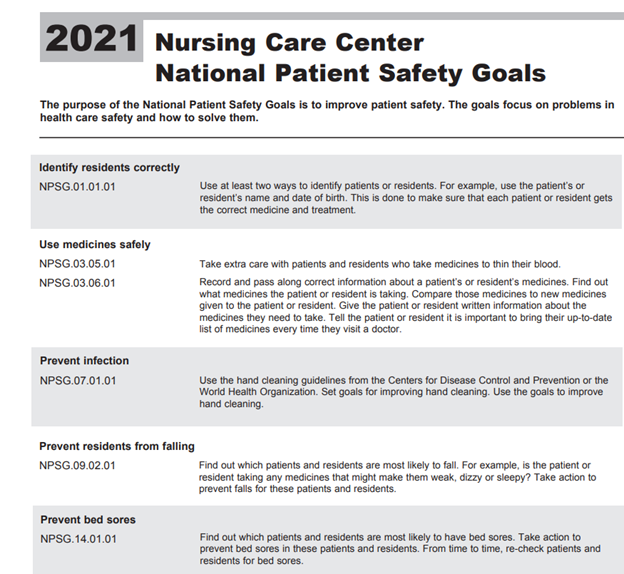
Each year The Joint Commission gathers information about emerging patient safety issues from widely recognized experts. They use this information to develop the National Patient Safety Goals which are tailored to each specific healthcare setting, such as Nursing Care Centers (SNFs), Hospital based, and Home Care. All in all, they have developed eight sets of goals for different sites of service.
The number one goal has been Identify Residents/Patients Correctly for over ten years. In all eight areas of service, The Joint Commission has placed Identify Residents/Patients Correctly in the number one spot. Every site of service, Hospitals, Ambulatory Care, Behavioral Care, Critical Access Hospitals, Home Care, Laboratory Services, Nursing Care Centers (SNFs), and Office Based Surgery, all indicate that Identify Residents/Patients Correctly is the number one priority for patient safety.
The gold standard for patient identification is at least two patient identifiers. Many places ask the patient’s “name and date of birth” and compare against your records. Cognitively challenged patients present challenges if asked to repeat name and date of birth. This is predominantly challenging in a healthcare setting where patients do not wear identifying arm bands. Using bed number is NOT an effective means to ID a patient, particularly in a situation where roommates may end up in wrong bed or patients wander in and out of rooms. Healthcare organizations should consider taking photos of patients and including those images in medical records where this would help clinicians to see that they are treating the right patient. Without a standard process for identifying your patients correctly you are placing them at risk for treatment errors and your practice at risk for billing errors. Each patient ID error has potential to cause devastating damage to patient and/or relationships with communities that we serve.
Correctly identifying patients is the first basic patient right and should be taken seriously. Each and every time you provide care you should first ensure “right patient.” See below for 2021 published National Patient Safety Goals for Nursing Care Centers and Home Care.

Resources: Wikipedia and The Joint Commission