
Patients are being discharged from facilities often at a functional level below what is necessary to be independent in their home and community, which can lead to a high risk for falls and rehospitalizations. We might want to blame the insurance companies and short length of stays or the complexities of the patient, but I want to take a moment and ask a serious question about our treatment strategies.
Is my patient tired at the end of the therapy session? Are they reporting DOMS (delayed onset muscle soreness) at their follow up session? Does my plan of care align with the variety of activities the patient will need to perform and be successful in their home?
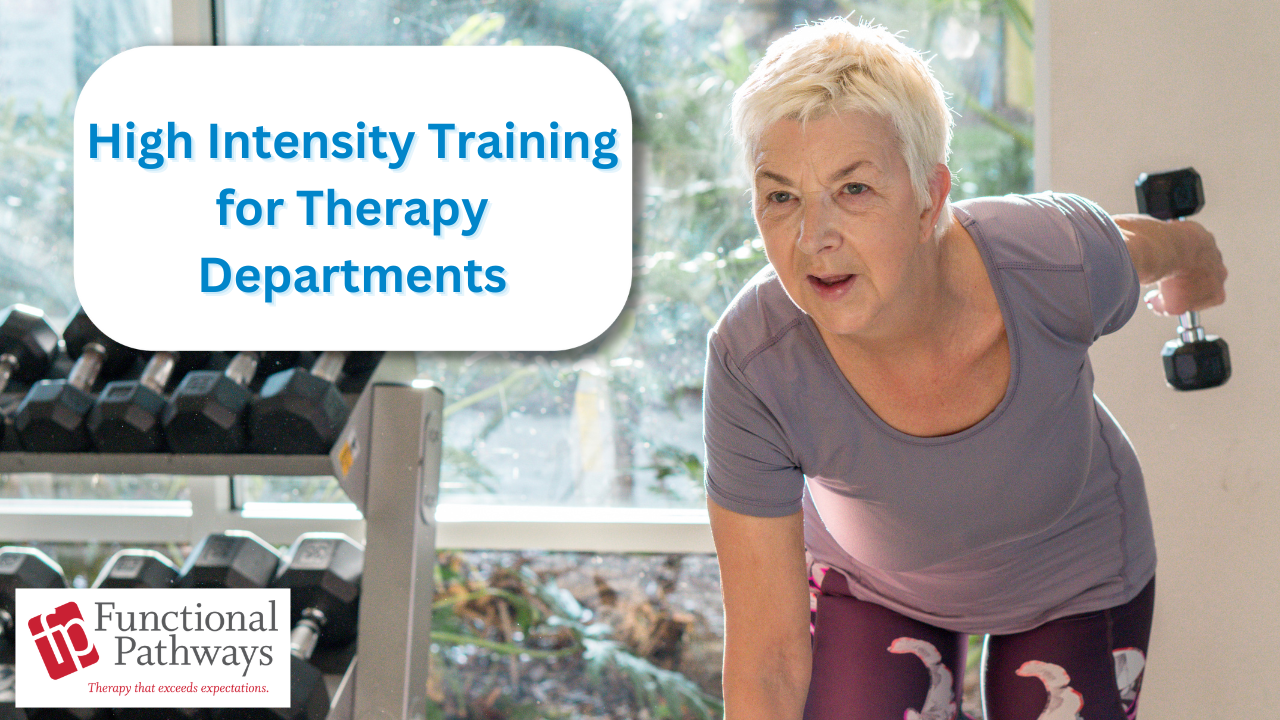
High Intensity Training is a program that combines cardiovascular, endurance, strength, core, and agility exercises. This method of training requires little or no equipment and utilizes the patient’s body weight to keep the heart rate and intensity in a therapeutic range.
So now that we have the definition, how do we put this into therapy practice? A patient must perform at a level that EXCEEDS their “accustomed activity” or normal activity to gain muscle strength and functional performance. That means that simply putting an ankle weight on a patient and asking for 3 sets of 10 large arc quads in a seated position is not going to improve patient strength, performance, or outcomes. Each quadricep muscle group is asked to support half of the body weight during a sit to stand transfer, so let’s do 3 sets of 10 sit to stands.
From session to session, a patient must experience an increasingly challenging program to improve in strength and function, or the body will adapt to the exercise. If adaptation occurs, then there will be no improvement in strength and function.
So, if we start out by having them work on sit to stand, we can progress to not allowing use of their hands, changing the height of the surface, vary the surface, and eventually putting a weight in their hands to mimic a functional activity like carrying the mail, groceries, or laundry. Think about the potential outcomes for our patients when we make intensity and function a priority.
There are many more aspects of High Intensity Training that would benefit our patients like the role of vital signs, the concept of 8 increase the weight, perturbations, timing of activities, varying surfaces, head/neck movements, acceleration/deceleration, turns, obstacles, and occupational-based practice. So, look for more to come from the Functional Pathways clinical team on High Intensity Training in 2023.