
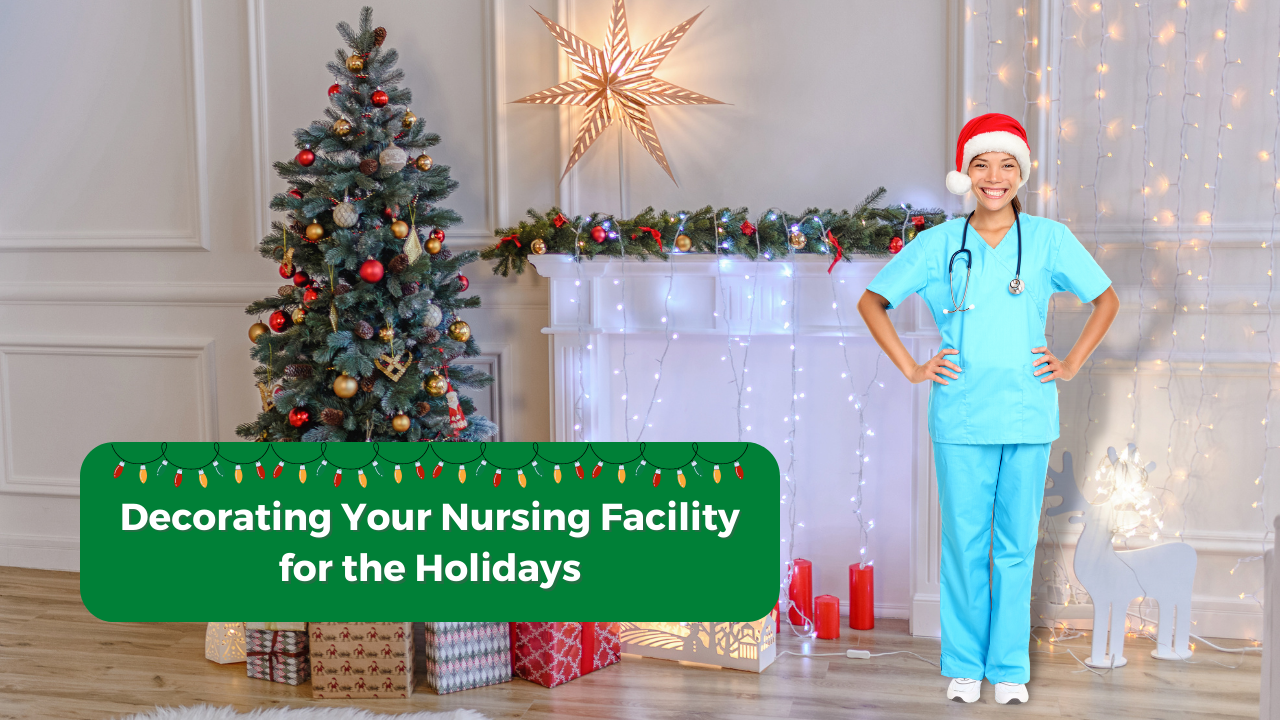
Residents that must spend the holidays in a nursing facility appreciate your decorating efforts of garlands, lights, wreaths, and tinsel. Does your facility have a policy on holiday decorations for both public spaces and the resident’s private rooms? Here is a list of some best practices to follow when decorating for the holidays.
Flame-Resistant
Artificial Christmas trees and decorative foliage must be labeled flame retardant or resistive. Ensure that your tree is away from heat sources such as a fireplace or heaters. Do not use electric holiday lights on metallic trees.
Combustible decorations must be flame retardant as well. Limited quantities may be acceptable; however, in more significant amounts, they are not. The National Fire Protection Association Life Safety Code limits the number of combustible materials displayed on interior walls and ceilings to no more than 10%. If more than 10% of the wall or ceiling areas are decorated, over 10% must be documented as flame retardant. The 10% includes photographs and paintings.
No Obstructions
Do not block exits, exit signs, or any fire safety equipment. Areas that include pull stations for fire alarms, fire extinguishers, notification signs for exits, or directions for alarm notifications are also off-limits.
Do not hang decorations from sprinkler heads. Any object hanging from the ceiling must not be placed closer than 18 inches from a sprinkler head. Many facilities will prohibit hanging decorations from the ceiling.
Hanging Lights
The Life Safety Code Section 19.7.5.6 does not address holiday lights. However, use light strands that carry the UL label. Remember that your federal and state agencies have electrical and building safety standards. Therefore, do not use extension cords or real flaming candles as part of your holiday decorations. Inspect each electrical ornament or string of lights by observing for cracked or frayed sockets, loose or bare wires, and loose connections. Once it has passed your observation inspection, plug it in for 15 minutes while observing. If there aren’t any issues, use it, but if they are flickering or will not light up, dispose of it. Do not staple or nail through the electrical wires. Read the packaging and follow the use and care instructions, especially the maximum number of strings that may be linked together. Use automatic timers to turn on and turn off your holiday lights. Avoid overloading electrical outlets.
Plant Safety
Certain plants specific to the holidays — such as poinsettia, mistletoe, holly, and hemlock — have been known to be toxic. They can have next to no issues or can be seriously harmful. Ensure you research the plants you want to display for potential ingestion hazards.
Guests of Residents
Along with looking at the common areas, don’t forget that families are also decorating the rooms of their loved ones. Train your staff to assist you in safety rounds regularly in identifying unsafe lights, extension cords, clutter on windowsills, and wreaths hung on residents’ doors that may interfere with the opening or closing of the door. Ensure all your staff is educated on your facility’s holiday decorating policy and are assisting you in identifying safety issues with holiday decorations.
Here is the link to the Life Safety Code requirements from CMS:
https://www.cms.gov/Medicare/Provider-Enrollment-and-Certification/CertificationandComplianc/LSC
Here is the link to the Life Safety Code and Health Care Facilities Code (HCFC) from CMS:
https://www.cms.gov/Medicare/Provider-Enrollment-and-Certification/GuidanceforLawsAndRegulations/LSC